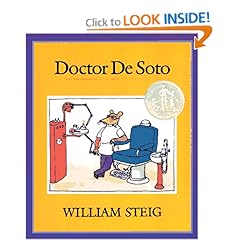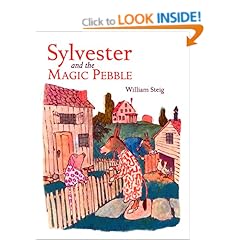
Biography of William Steig: William Steig was born in New York City in 1907. In a family where every member was involved in the arts, it was not surprising that Steig became an artist. After public school he went to City College and attended the National Academy of Design. In 1930, Steig's work began appearing in The New Yorker, where his drawings have been a popular fixture ever since. He published his first children's book, Roland the Minstrel Pig, in 1968, embarking on a new and very different career.
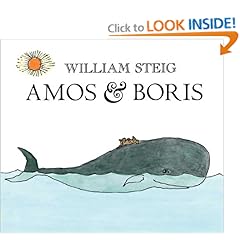
Steig's books reflect his conviction that children want the security of a devoted family and friends. When Sylvester, Farmer Palmer, Abel, Pearl, Gorky, Solomon, and Irene eventually get home, their families are all waiting, and beginning with Amos and Boris, friendship is celebrated in story after story.
In 1970, Steig received the Caldecott Medal for Sylvester and the Magic Pebble. His books for children also include The Amazing Bone, a Caldecott Honor Book; and Abel's Island and Doctor De Soto, both Newbery Honor Books. Other awards and honors which Steig's books have received are the Christopher Award (Dominic), the Irma Simonton Black Award (Gorky Rises), the William Allen White Children's Book Award (Dominic), and the American Book Award (Doctor De Soto, co-winner). His European awards include the Premio di Letteratura per l'infanzia (Italy) for The Real Thief, the Silver Pencil Award (the Netherlands) for Abel's Island, and the Prix de la Fondation de France for Dominic. On the basis of his entire body of work, Steig was selected as the 1982 U.S. candidate for the Hans Christian Andersen Medal for Illustration and subsequently as the 1988 U.S. candidate for Writing.
Beginning with About People in 1939, William Steig has published thirteen collections of drawings for adults, among them The Lonely Ones, Male/Female, The Agony in the Kindergarten, and, in 1990, Our Miserable Life. His most recent books published by Farrar, Straus and Giroux are Shrek! (released by DreamWorks as a major motion picture) and Wizzil, illustrated by Quentin Blake. School Library Journal named Shrek! a Best Book of 1990 and said of it, "Steig's inimitable wit and artistic dash have never been sharper or more expertly blended."
Alice615,
You may refer to my posts in this thread regarding the books read by my younger daughter. She is now just 40 months old only. The books i mentioned in the threads are all read by her before Age 3. So, you may see if they suit the taste of your baby.
原帖由 jychan 於 10-3-4 18:02 發表
Alice615,
You may refer my posts in this thread regarding the books read by my younger daugher. She is now just 40 months old only. The books i mentioned the threads are all read by her before Age 3. ...
Thanks for your sharing,
seen those chinese version books you have suggested, very interested,
but i seldom buy Chinese books,
is there any specific shop you would suggest is good to buy these books?
For Chinese books, I usually buy in HK bookstores. In fact, my daughters love English books more and so I usually buy them English books.
I also like to shop in Dxxgdxxg or amazXX.cn for some picture books in simplifed chinese version.
原帖由 lcip 於 10-3-24 16:06 發表
hi jychan,
Thanks for your sharing,
seen those chinese version books you have suggested, very interested,
but i seldom buy Chinese books,
is there any specific shop you would suggest is good to buy ...
Every child has secrets, and many secrets are fun to keep—for instance, a surprise birthday gift for Mom, or a secret handshake with a young friend. But sometimes, children have secrets that make them feel bad, and these secrets are best shared with their parents, or with some trusted older person. A child who is bullied might be inclined to keep it secret, but it’s always best to tell parents about it. Or children who are touched intimately and improperly by an older person will soon feel better if they reveal the secret to parents. This book helps kids distinguish between good and bad secrets. Even very young children have concerns and anxieties, and Tell Somebody Books are written and illustrated especially for them. Parents are advised to read these books aloud while their preschooler listens and looks at illustrations of the boys and girls in each story. Many children in early grades will be able to read the stories for themselves. Tell Somebody Books encourage children to explore their feelings, and then to speak openly about things that trouble them.